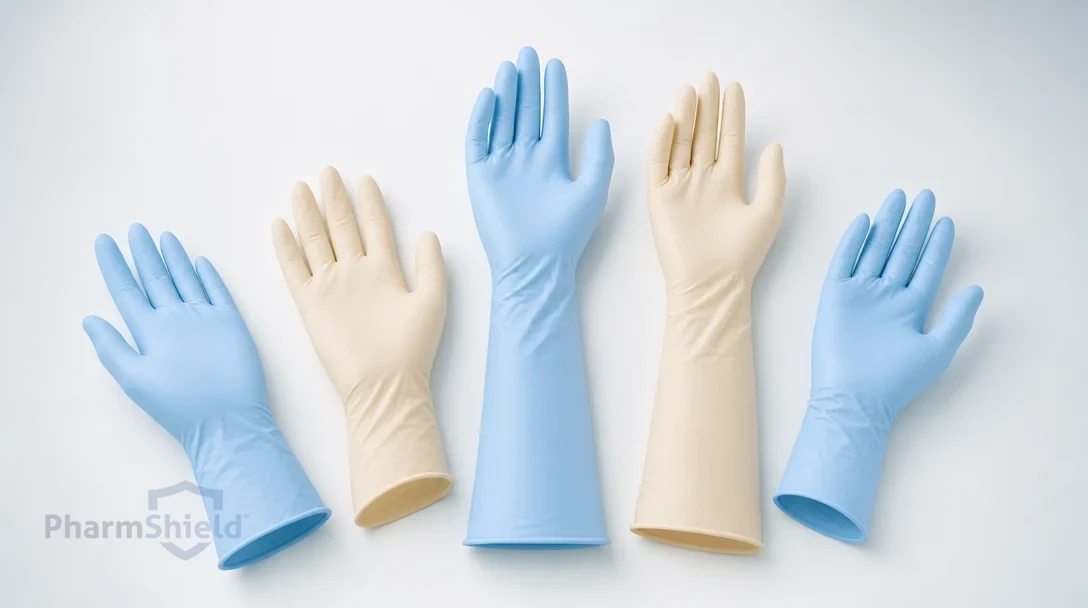
An examination glove is defined by surprisingly little: the standard sets only a minimum length, minimum thickness, and minimum strength. Everything else is open: the material, exact length, thickness, coating, packaging, and whether it’s sterile. That openness is what lets the same title of “examination glove” be used for everything from a hospital ward to a cleanroom environment. Because of that variation, choosing well means choosing the set of variables that suits your process.
What the standard actually requires
The examination-glove standards (ASTM D6319 for nitrile, D3578 for latex) specify only minimum parameters, not a single product:
- Minimum length: 240 mm from fingertip to cuff edge.
- Minimum thickness: measured at the finger and the palm.
- Minimum tensile strength: 14 MPa for nitrile (D6319) and 18 MPa for latex (D3578).
- Freedom from pinholes: batches sampled and tested at a defined AQL.
Any glove that clears those minimums can be called an examination glove. Just as important is what the standard doesn’t cover: coating, packaging, and sterility sit outside it entirely. So the real decision is in the variables the standard leaves open.
The variables that matter
Material: Nitrile (synthetic, chemical- and puncture-resistant, latex-free) or latex (natural rubber, best fit and feel). Customers have the choice between the two. To decide which material suits you, see our nitrile vs latex guide, or browse our nitrile and latex product ranges.
Cuff length: Standard-length gloves cover the wrist, as the standard specifies a minimum of 240 mm; extended-cuff gloves reach up the forearm for splash protection or to overlap a gown sleeve. The standard only sets the floor. As a customer, you can choose anywhere from 240 mm all the way up to 450 mm in the PharmShield range, with each length suited to a different use case, because pharma and laboratory work often calls for different cuff lengths.
Thickness: Thinner gloves give more tactile sensitivity; thicker gloves give more durability and chemical barrier. It comes down to fine handling versus heavier protection. The standard defines minimum thickness at the cuff, palm, and finger, but PharmShield gloves are designed at a higher specification for the durability that regulated pharma environments demand.
Coating: Every glove can be made by a powdered or a powder-free method. Powder-free gloves are now the standard for medical and pharma use; powdered gloves are banned in the US and restricted in the EU due to residual powder and allergenic risks. Because of the regulated environments our customers typically operate in, all PharmShield gloves follow the powder-free method. How a glove is made powder-free still matters for sensitive environments.
Packaging:Packaging isn’t mentioned in the standard at all, yet it’s one of the biggest practical choices: the right format depends on the end process the gloves are used in. Our packing ranges from a non-sterile dispenser box to individually packed and single- and triple-vacuum-packedformats that protect the glove and support cleanroom entry. Whether it’s a non-sterile use case, a critical environment, or a cleanroom, we offer a full range catered for it.
Sterilisation: Gloves fall under non-sterile or sterile, and sterilisation can be done by two methods: EtO or gamma. Non-sterile gloves are typically used in non-critical areas for general examination and handling; EtO- or gamma-sterile gloves are used in more stringent, critical processes where the glove may come into contact with the pharma product being manufactured, or where the chemicals used in the process should not affect the user. Sterilisation is performed using a validated process in accordance with ISO 11135 (EtO) or ISO 11137 (gamma) to achieve a Sterility Assurance Level (SAL) of 10⁻⁶.
Matching the glove to the process
A few examples of how the variables stack up:
- General use: where you just need simple hand protection against dirt and contamination, non-sterile nitrile or latex at standard length, from a dispenser box, is sufficient.
- Laboratory / QC lab: where you may be handling chemicals and solvents, consider powder-free nitrile with an extended cuff to protect against splashes and spills. You can learn more in our product range for labs.
- Pharma manufacturing, cleanroom, food & beverage: sterile nitrile or latex, with higher levels of packaging and more stringent coating than the standard defines: double-chlorinated, vacuum- or triple-vacuum-packed. You can learn more in our product range for pharma.
PharmShield’s range
PharmShield offers examination glovesmade from nitrile and latex, across packaging formats from dispenser boxes to vacuum-packed sterile grades, with every variable specified above the standard’s minimums. Powder-free, tested to ASTM D6319 (nitrile) and D3578 (latex), inspected to AQL 0.65 for premium quality assurance. Choose the material, thickness, cuff length, and sterilisation that match your process. Contact us with your requirementsand we’ll recommend the right spec and send samples.