Chemical-Resistant Nitrile Gloves EN 374, for pharma & lab handling.
PharmShield chemical-resistant gloves are EN 374-tested nitrile gloves for pharmaceutical, laboratory and food-handling environments — protecting against splash and incidental contact with reagents, solvents and cleaning chemicals. These are precision disposable gloves built to a standard, not heavy-duty industrial gauntlets: powder-free, AQL 0.65, batch-traceable, with sterile and cleanroom-ready options. If you’re matching a glove to a chemical and a breakthrough time, start with the EN 374 data below.
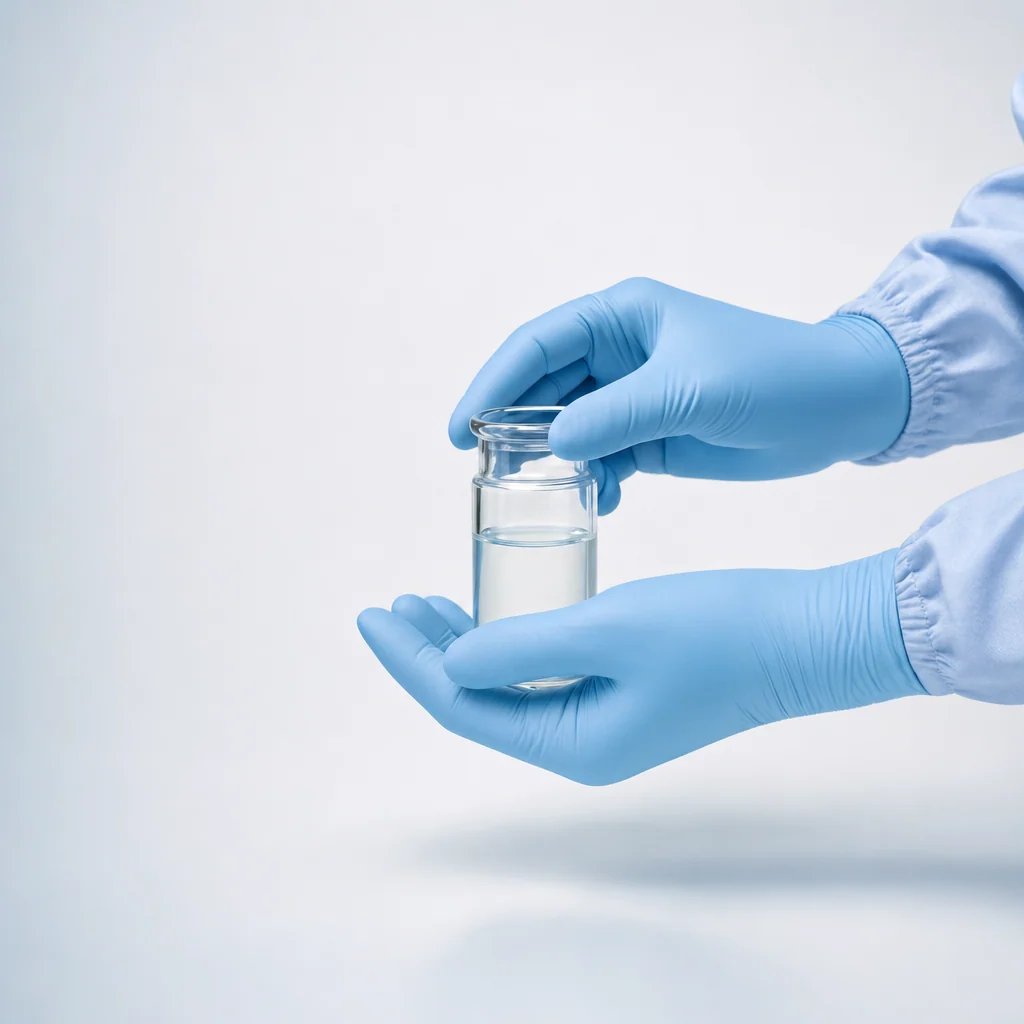 EN 374 Tested
What EN 374 actually tests.
Chemical resistance isn’t one number — EN 374 measures three things, and a right-fit choice reads all three together.
How Long Before It Passes Through
Permeation measures how long a chemical takes to migrate through intact glove material at a molecular level. The result is a breakthrough time, graded Level 1 (>10 min) to Level 6 (>480 min) — the number you match against the specific chemical you handle.
No Pinholes, No Leaks
Penetration testing checks that the glove has no holes or seam failures that would let liquid pass straight through. It ties directly to the AQL — PharmShield nitrile is built and 100% inspected to AQL 0.65 for barrier integrity.
Does the Material Hold Up
Degradation assesses whether contact with a chemical physically changes the glove — swelling, hardening or weakening it. A glove can resist permeation yet still degrade, which is why right-fit selection always reads all three results together.
Permeation breakthrough levels
EN 374 gradingThe higher the level, the longer the glove resists a specific chemical before breakthrough. Match the level to your chemical and your exposure time — a glove rated highly for one solvent may rate low for another.
Important: PharmShield nitrile gloves are tested to EN 374 methods for splash and incidental-contact protection. They are not immersion-rated chemical gauntlets and are not intended for dipping, prolonged contact or heavy-duty chemical handling. Always match the glove to the specific chemical and its breakthrough time.
How EN 374 grades a glove — Type A, B and C.
EN 374-1 sorts gloves by how many test chemicals they hold back, and for how long. Thin disposable nitrile sits in the splash-protection band — exactly where pharma and lab incidental-contact work lives.
Breakthrough time of at least 30 minutes against at least six test chemicals from the standard list. The broadest protection class in the EN 374 scheme.
Breakthrough time of at least 30 minutes against at least three test chemicals — a balanced class for defined laboratory and process reagents.
Breakthrough time of at least 10 minutes against at least one test chemical — the low-level splash-protection class typical of thin disposable nitrile.
Splash protection vs immersion — and which one we make.
Disposable nitrile splash protection — what we make
- check_circleSplash, spray and incidental contact with reagents, solvents and cleaning chemicals.
- check_circlePharma production, analytical and R&D labs, food handling — precision tasks at sample scale.
- check_circleYou need barrier integrity (AQL 0.65), tactility and contamination control to a standard.
- check_circleSingle-use hygiene matters — change gloves between tasks, no cross-contamination.
A heavy-duty gauntlet — when you need a different product
- removeImmersion — dipping or submerging hands in a chemical bath.
- removeProlonged or repeated direct contact well beyond a brief splash.
- removeHeavy industrial degreasing, paint, large-volume solvent or acid transfer.
- removeMechanical hazards alongside chemicals — abrasion, cut or puncture risk.
For those tasks you need a thick, reusable immersion gauntlet — a different product class that PharmShield does not make.
Chemical-resistant nitrile gloves.
The same powder-free, AQL 0.65 nitrile that protects against contamination is tested to EN 374 for chemical splash protection — available non-sterile for everyday bench work, and sterile, vacuum-packed for cleanroom lines where chemical contact and aseptic processing meet.
Specifications
Where chemical splash protection matters.
The right-fit buyer matches a glove to a reagent and a breakthrough time — in regulated, precision environments.
Pharmaceutical
Reagent handling, formulation and QC labs — splash protection against solvents and cleaning chemicals in regulated production.
Explore the industrychevron_rightLaboratories
Analytical and R&D benches handling acids, bases and solvents at sample scale — matched to a breakthrough time, not immersion.
Explore the industrychevron_rightFood Handling
Sanitiser and cleaning-chemical contact in food processing — incidental-contact protection with food-safe, powder-free nitrile.
Explore the industrychevron_rightChemical resistance is one line in your glove program.
Most facilities standardise on one nitrile platform and configure it per area. Explore the full range, or the antistatic line where static control and chemical splash protection meet on the same bench.
The complete nitrile range
Specs, sterility options and standards across every PharmShield nitrile configuration — the hub for matching a glove to each area of your operation.
Explore the nitrile hubarrow_forwardboltESD antistatic nitrile
For electronics and EV lines that need static-dissipative control alongside chemical splash protection — the combined static + chemical configuration.
Explore ESD antistatic glovesarrow_forwardChemical-resistant gloves — FAQ
Straight answers on what EN 374 means, what nitrile protects against, and the honest line between splash and immersion.
Yes — to a point, and that point is what EN 374 measures. Nitrile resists many solvents, oils and cleaning chemicals far better than latex, and PharmShield nitrile is tested to the EN 374 methods for permeation, penetration and degradation. The protection it gives is splash and incidental-contact protection — not the immersion-grade protection of a heavy industrial gauntlet. Always match the glove to your specific chemical and its breakthrough time.
EN 374 is the European standard for gloves giving protection against chemicals and micro-organisms. It defines how a glove is tested for permeation (breakthrough time, graded Level 1–6), penetration (no holes or leaks) and degradation (whether the chemical damages the material), and classifies gloves as Type A, B or C by how many chemicals they resist. Our deeper EN 374 explainer walks through each test. Read the EN 374 explainer →
Nitrile offers good resistance to many solvents, acids, bases, oils and cleaning agents encountered in pharma and lab work — but resistance is always chemical-specific. A glove can resist one solvent for hours and another for minutes. Use EN 374 permeation data to match the glove to the exact chemical and the breakthrough time your task requires, rather than assuming blanket protection.
For splash and incidental contact during reagent and solvent handling — yes. For immersion, prolonged contact or heavy-duty chemical work — no. PharmShield makes precision disposable nitrile gloves for pharma, lab and food environments, not thick reusable chemical gauntlets. If your task involves dipping hands into a chemical or extended exposure, you need an immersion-rated gauntlet, which is a different product class.
Yes. The PharmShield Nitrile Vacuum-Packed Sterile glove combines EN 374-tested chemical splash protection with validated sterile barrier protection (SAL 10⁻⁶, ETO or Gamma) and vacuum packaging for controlled cleanroom transfer — for aseptic processing where both contamination and chemical contact are in scope. See the sterile vacuum-packed nitrile →
Matching a glove to your chemicals?
Send us the chemicals you handle, your environment and your volumes — our team will respond with EN 374 chemical-resistance data, the right configuration and a spec sheet.