Production & Quality series · Part 1 of 2 · Read Part 2
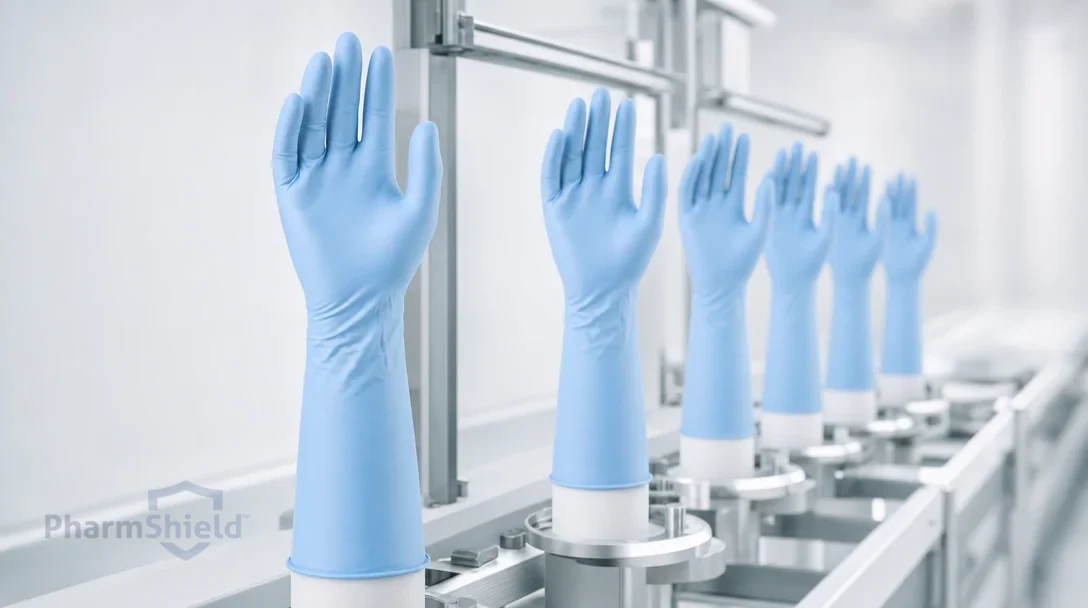
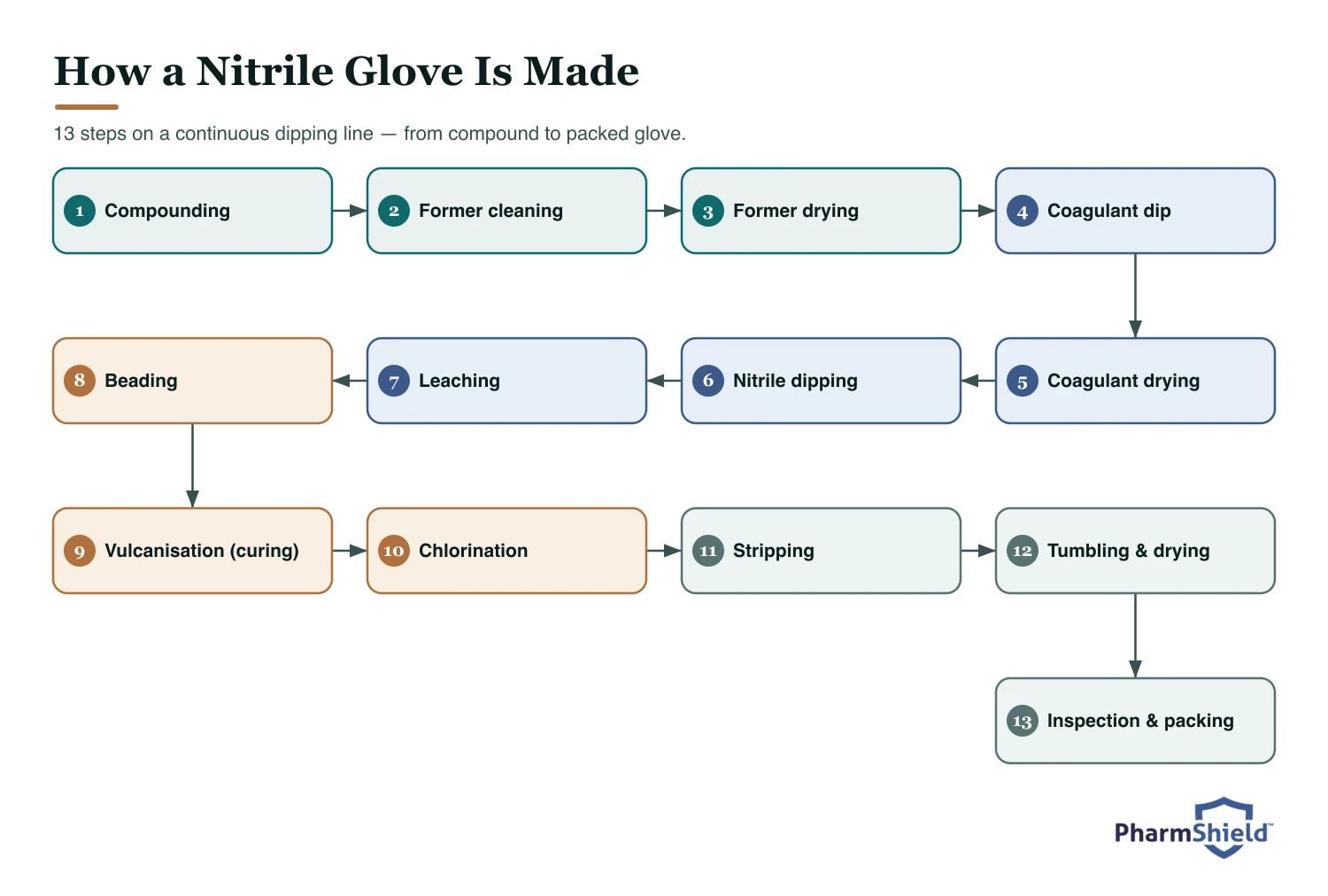
Nitrile gloves are manufactured by dipping hand-shaped moulds (known as formers) into a liquid nitrile compound, followed by curing, washing, and removing the finished gloves from the formers. The process runs on a continuous production line, where ceramic hand-shaped formers travel through a series of preparation, dipping, curing, washing, and finishing stages. As the formers move through each stage, a nitrile glove is progressively formed before being removed, inspected, and packed. Below is a step-by-step overview of the complete manufacturing process.
The process, step by step
- Compounding the nitrile. Nitrile butadiene rubber (NBR) latex is compounded with carefully selected ingredients, including curing agents, stabilisers, pigments, and other processing additives, to achieve the required glove properties. The formulation is mixed under controlled conditions for consistency, quality, and performance, then supplied to the dipping line once the compound is checked and approved by the QA team.
- Former cleaning. The ceramic hand-shaped formers are thoroughly cleaned using alkali and acid solutions, then rinsed with water to remove residues and contaminants. This gives a smooth former surface, so the nitrile compound coats evenly and produces defect-free gloves with consistent quality.
- Former drying. After cleaning, the ceramic formers are dried in a heated oven to remove any remaining moisture. Proper drying ensures good adhesion of the coagulant and promotes uniform glove formation during dipping.
- Coagulant dip. The dried formers are dipped into a coagulant solution, typically containing calcium nitrate and other additives. The coagulant helps the liquid nitrile compound adhere evenly to the formers, ensuring consistent glove thickness and uniform film formation.
- Coagulant drying. After the coagulant dip, the formers pass through a drying oven to remove excess moisture and set the coagulant layer. This ensures uniform adhesion of the nitrile compound during the next stage.
- Nitrile latex dipping. The prepared formers are dipped into the compounded nitrile latex, where a uniform layer of nitrile adheres to the coagulant-coated surface. Thickness is controlled by the formulation and dipping parameters to meet the required product specifications.
- Leaching. The freshly dipped gloves pass through hot-water leaching tanks to remove excess chemicals, residual coagulant, and other water-soluble processing residues. This produces cleaner gloves with lower chemical residues and improved user comfort.
- Beading. The cuff edge is rolled into a bead, the raised rim that gives the cuff strength and makes the glove easier to don.
- Curing. The gloves pass through heated ovens where the nitrile compound is cured (the technical term is vulcanisation). This cross-links the rubber molecules, giving the gloves their required strength, elasticity, durability, and chemical resistance.
- Chlorination. The cured gloves undergo a chlorination process to reduce surface tackiness, so they don easily without any additional coatings applied onto the gloves, such as polymers. PharmShield produces powder-free gloves using a powder-free coagulant together with chlorination, rather than a polymer coating that can potentially flake. Depending on the product specification, gloves may be single or double chlorinated to achieve the desired surface finish and user comfort.
- Removing. The finished gloves are removed from the formers, often automatically or with an air assist, and the formers loop back to the start.
- Tumbling and drying. Gloves are tumbled and dried to remove any excess moisture and complete the curing process offline.
- Inspection and packing. Finished gloves undergo 100% visual inspection and quality checks to ensure compliance with specifications. Approved gloves are counted and packed to the required grade, including dispenser boxes, pouches, or vacuum packs. PharmShield follows 13 QA checkpoints from raw-material inspection to final release to maintain consistent quality.
From here
That’s how the glove gets made. What it doesn’t tell you is how a manufacturer makes everyglove in a batch come out the same: the testing, tolerances, and traceability that separate a reliable medical-grade glove from a cheap one. That’s the subject of Part 2: How PharmShield ensures glove quality and consistency.
PharmShield runs this process on a vertically integrated line in India. See our nitrile gloves or why PharmShield, or request a spec sheet.