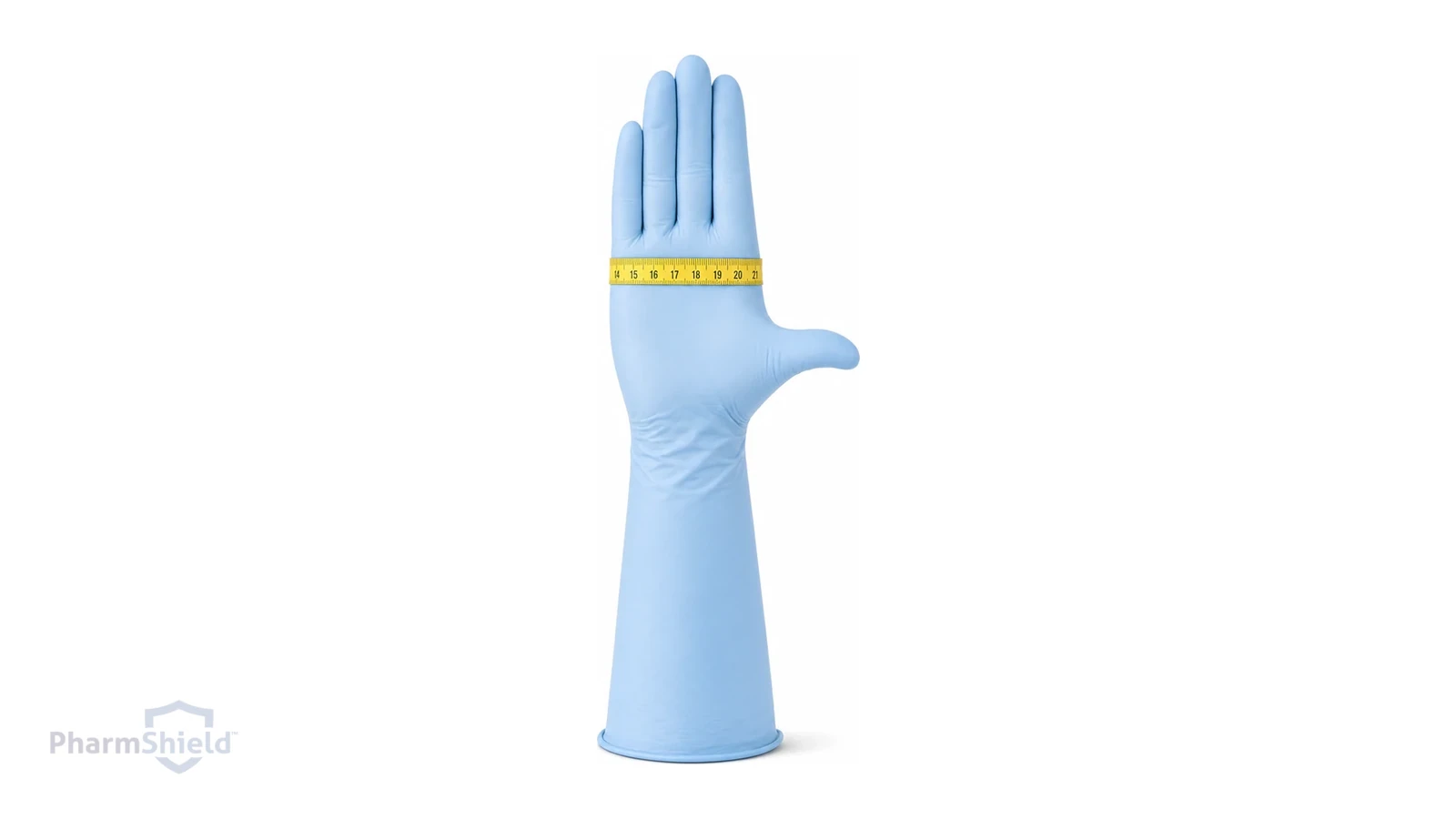
Your glove size is the circumference around your palm, measured in inches. Wrap a tape around the widest part of your palm, just below the knuckles, with your fingers together and your thumb excluded. The measurement in inches is your size: about 7 inches is a medium, 8 inches a large. It’s the distance around your hand that decides the fit, not the length of your fingers.
Here is how to measure, the full size chart, and why the same “medium” varies a little between brands.
Why fit matters more than it looks
A glove that’s too big is loose at the fingertips and simply doesn’t suit the wearer; too small and it fatigues the hand and stresses the material at the seams. Glove size is always about the individual — the right fit protects barrier integrity, task accuracy and comfort through a full shift. Getting the size right is one of the easiest things you can do to support better performance, better accuracy and a smoother process.
How to measure your hand
- Open your dominant hand flat, fingers together, thumb tucked aside.
- Wrap a soft tape (or a strip of paper) around the widest part of the palm, just below the knuckles. Don’t include the thumb.
- Read the measurement. If you used a paper strip, lay it flat against a ruler. Note it in centimetres or inches.
- Match it to the size chart below. The value in inches is your glove size.
If your measurement sits on the boundary between two sizes, sizing up is usually the right choice. Only where dexterity and tactile feel are critical — fine handling where you need to feel exactly what you’re doing — should you consider sizing down.
Examination glove size chart
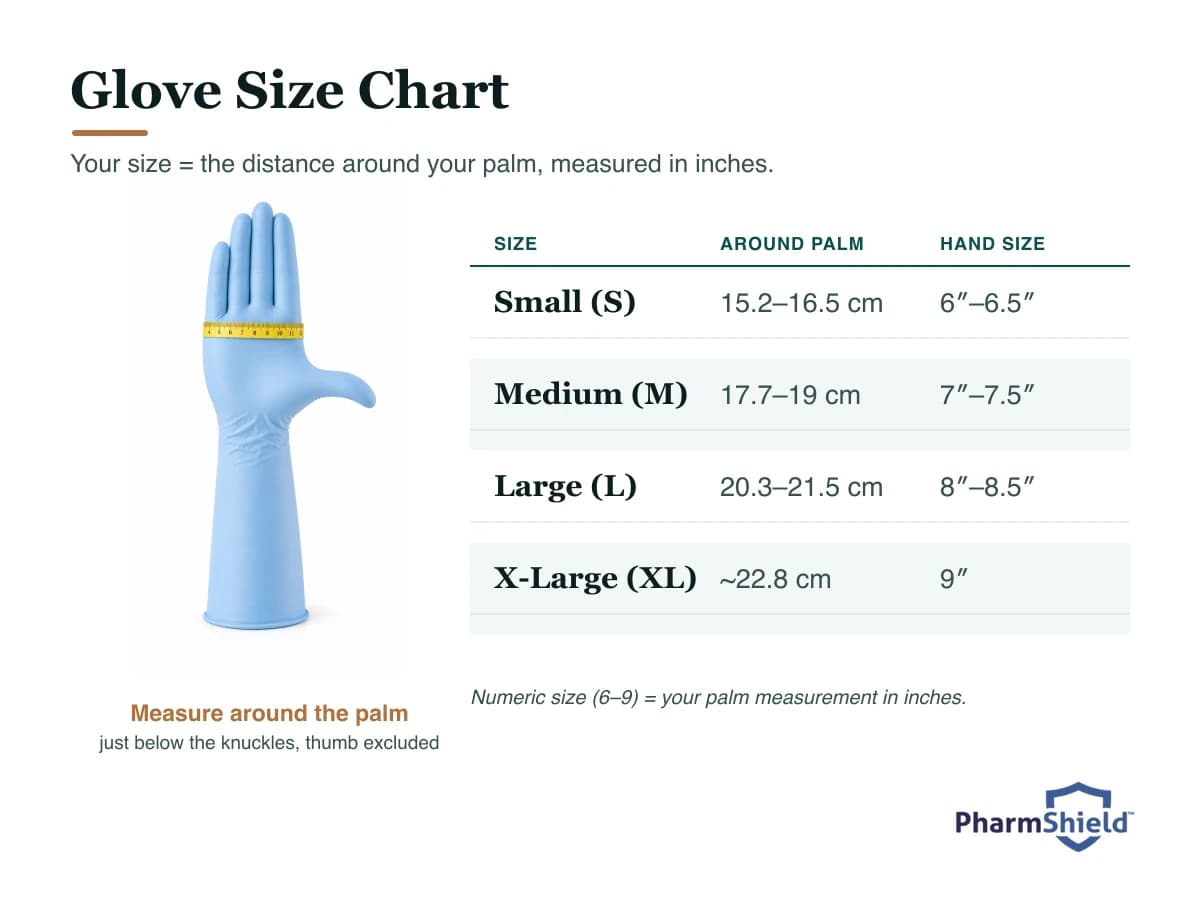
| Size | Around the palm | Hand measurement |
|---|---|---|
| Small (S) | 15.2–16.5 cm | 6″–6.5″ |
| Medium (M) | 17.7–19 cm | 7″–7.5″ |
| Large (L) | 20.3–21.5 cm | 8″–8.5″ |
| X-Large (XL) | ~22.8 cm | 9″ |
The numeric glove size you sometimes see (6, 7, 8, 9) is simply that palm measurement in inches. A 7-inch palm is a size 7, which is a medium.
We hold tight dimensional tolerances on every batch, so a box of our gloves fits the same way glove after glove. That batch-to-batch consistency is deliberate, and it’s what lets a facility standardise on a size with confidence.
Find your glove size
Why “medium” isn’t identical across brands
Every brand’s medium is slightly different, though never by much — and it comes down to how the sizing standard works.
- Glove sizing follows an ASTM standard based on palm width, and the standard sets a rangefor each size — with a small tolerance on palm width — rather than one fixed number. Most manufacturers work within that range, so two “mediums” can sit at slightly different points and still both be correct.
- There are separate ASTM standards for each material — ASTM D6319 for nitrile examination gloves and ASTM D3578 for latex examination gloves — so a nitrile medium and a latex medium are each held to their own dimensional spec.
- Within a single brand, the glove-to-glove variation is minimal (fractions of a millimetre, former to former). The larger differences show up between brands, because each lands at a different point within the allowed range.
Choosing sizes for your facility
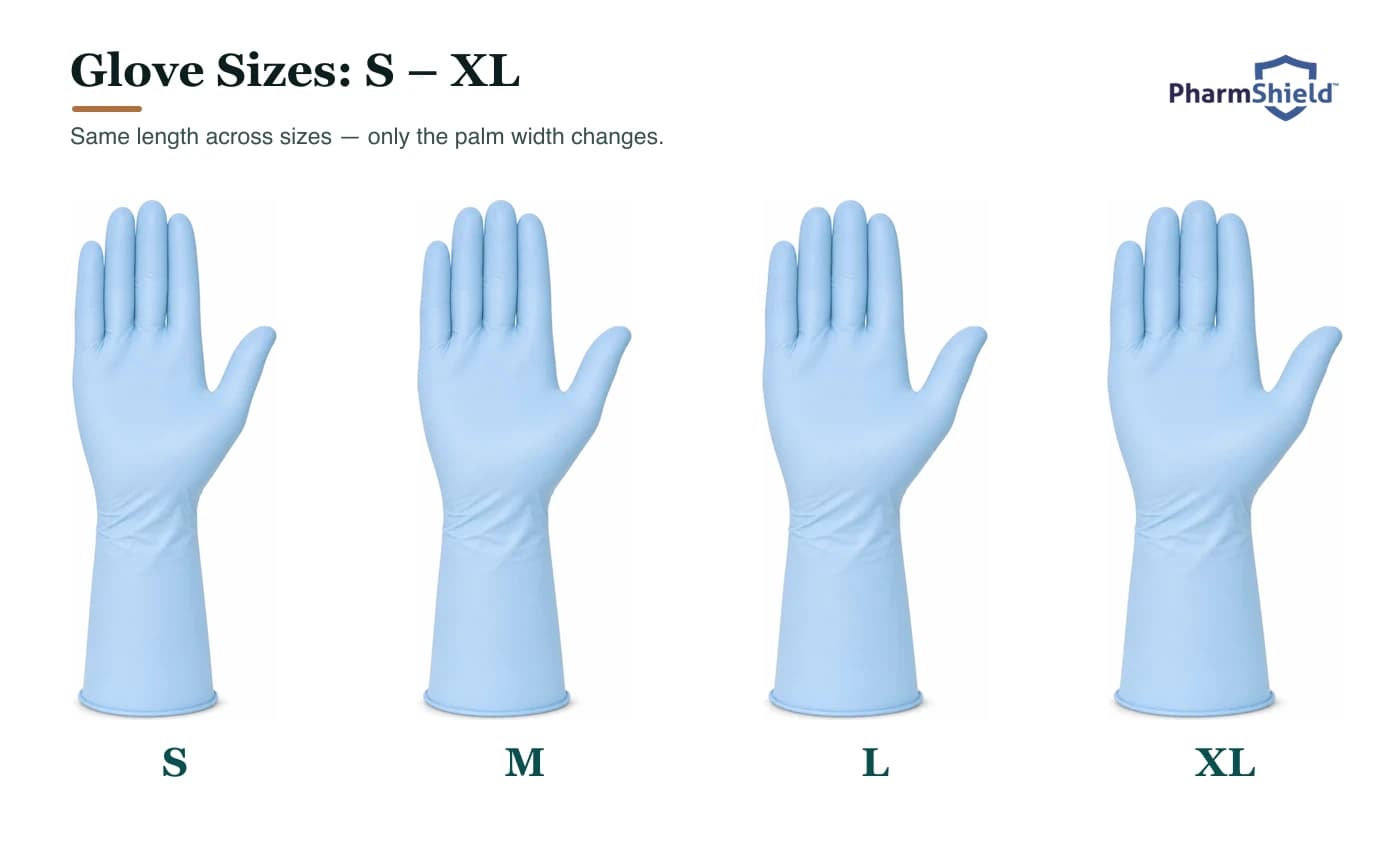
Medium is typically the average hand size, but small, large and extra-large all account for real volume across a workforce. It’s usually a mistake for a purchasing team to standardise on a single sizefor the whole company — with hundreds of different workers, one size will be loose on some and tight on others. Where a glove is too loose it can slip or let contamination in; where it’s too tight it tears more easily, pushing glove consumption higher than it should be. Stocking a spread of sizes — weighted toward medium — avoids both.
If your work is fine-motor (lab pipetting, electronics, inspection), bias toward a snugger fit. If it involves frequent donning and doffing or layering, a slightly looser fit speeds the line. PharmShield supplies examination gloves across the full size range, including nitrileoptions, and we can match a sample set to your team’s hand sizes before a bulk order. Request samples.